Manufacturing Recruitment for Production-Critical Environments
Shift patterns. Induction capacity. Site readiness
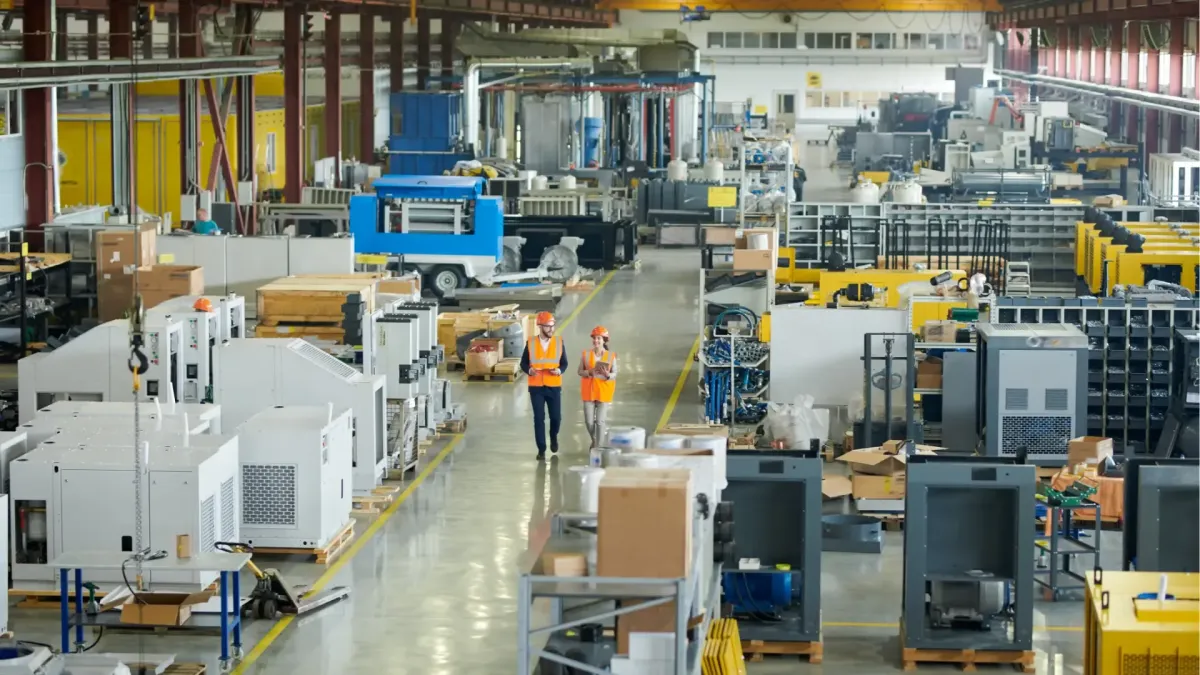
Manufacturing recruitment operates inside production systems where labour is inseparable from throughput, quality, and control. Unlike office-based environments, manufacturing relies on line-dependent operations, fixed sequences, and tightly governed processes.
5.0/5 Rating on Google - Based on 80+ Reviews
Trusted by Employers. Industry we serve. Integrated with Google Reviews.





What is Manufacturing Recruitment in Production Environments
Manufacturing recruitment sits inside line-dependent production systems.
Labour directly affects throughput, quality, and control.
Each role supports a fixed point in the production flow.
A single gap can disrupt output and increase pressure across the line.
Staffing choices create immediate operational consequences.
Absence breaks continuity.
Skill gaps increase scrap, rework, and compliance exposure.
Induction limits safety and supervision capacity.
Recruitment functions as a system input, not an HR activity.
Attendance reliability, shift tolerance, and time-to-competence determine stability.
A technically capable worker who cannot sustain the shift pattern still represents risk.
Line dependency
One missing or under-prepared role can interrupt flow and reduce overall output.
SOP control
Production depends on repeatable, governed processes rather than individual discretion.
Throughput sensitivity
Minor delays compound into missed targets, rework, and dispatch failures.
Induction throughput
Safe starts are limited by training capacity, supervision availability, and site readiness.
Absence
→ line stoppage → missed output
Skill gap
→ scrap and rework → compliance exposure
Overtime reliance
→ fatigue → safety incidents
Why Generic Recruitment Models Fail on the Factory Floor
Generic recruitment models prioritise speed and availability. They assume roles are interchangeable and output recovers through headcount alone. That logic breaks in production environments. Factory work is constrained by line balance, SOP adherence, and induction capacity. Starting people without site readiness creates churn, training waste, and instability.
Early-stage failures carry operational risk. Inadequate induction increases safety exposure and supervision load. Skill mismatch increases scrap, rework, and compliance pressure. Absence during the first weeks disrupts continuity when tolerance is lowest.
On the factory floor, speed without readiness amplifies risk. Staffing decisions that ignore shift tolerance, time-to-competence, and line dependency undermine control rather than restoring it.
Recruitment as Operational Risk Management
We support employers operating at Markham Vale. Recruitment decisions directly influence availability, performance, and quality on the factory floor. In production environments, staffing stability protects throughput and operational control. The temporary staffing for operational and support roles.
Unreliable attendance
→ unplanned downtime and schedule instability.
Misaligned capability
→ slower cycles and higher error rates.
Weak induction control
→ safety drift and quality escapes.
When recruitment is treated as risk management, staffing decisions support continuity instead of amplifying volatility.

A stable workforce reduces overtime pressure and limits defect risk. Controlled onboarding reduces first-week disruption and supervision load.

Shift Patterns. Attendance. Fatigue
Shift structure influences workforce reliability more than job titles or skill level. In manufacturing environments, availability is shaped by when work happens, not just what work is performed.
Rotating shifts, night work, and extended hours increase fatigue exposure and reduce tolerance over time. As fatigue accumulates, error rates rise and recovery time lengthens. Reliability becomes harder to sustain even among technically capable workers.
Transport and start-time logistics add further pressure. Early starts and late finishes increase punctuality risk where public transport is limited or unavailable. Small delays at shift handover points can cascade into missed targets across the line.
From an operational perspective, shift design determines how resilient the workforce is under pressure. Attendance patterns, fatigue accumulation, and recovery windows must be treated as production variables rather than personal factors.
Role Families in Manufacturing Operations
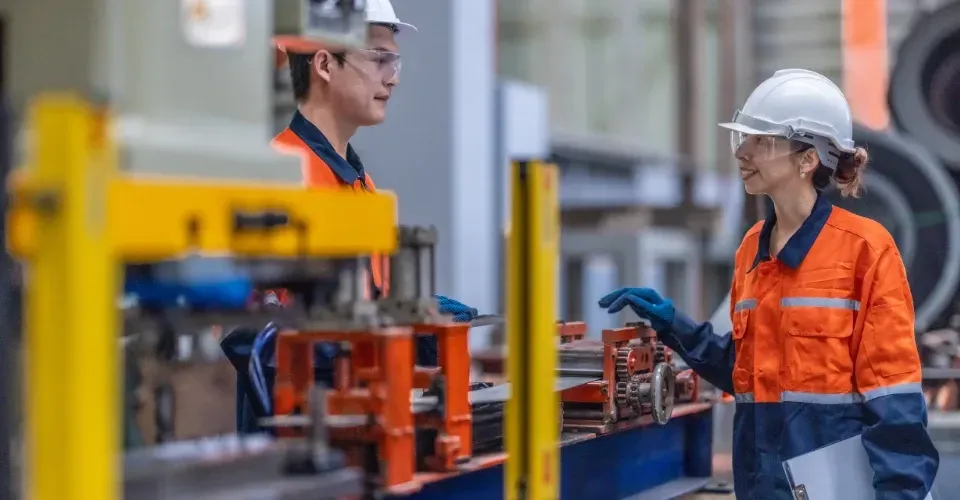
Manufacturing staffing works best when roles are grouped by functional families, not job titles. Each family supports a different operational constraint within the production system. Shortages do not create equal impact across the factory floor. The effect depends on where the role family sits in the process and what it protects. Understanding these differences is essential for maintaining flow, quality, and uptime.
Production and assembly
Maintain line flow, takt discipline, and SOP adherence.
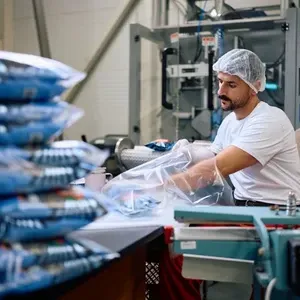
Processing and packaging
Control transformation steps, containment, and changeovers.

Quality and
compliance
Prevent quality escapes through checks, records, and verification.

Maintenance and site support
Protect uptime through planned and reactive intervention.
Temporary Workforce Usage in Manufacturing
Temporary workforce usage supports volatility and short-term operational coverage. Manufacturing demand fluctuates through seasonality, promotions, contract wins, and supply chain variation.
Temporary staffing protects continuity when output requirements change faster than permanent headcount can adjust. It stabilises the line during predictable peaks and absorbs short-duration pressure.
This model works best where tasks are repeatable, training is structured, and onboarding capacity is controlled. Clear SOPs, defined workstations, and stable supervision reduce ramp-up friction. Temporary staffing fails when induction capacity is exceeded. If supervision bandwidth, PPE readiness, or training slots are constrained, first-week churn increases and error risk rises.'
Volume without readiness amplifies disruption rather than protecting continuity. Temporary workforce usage must therefore align with operational tolerance, not just hiring speed.
Operational takeaway
Temporary workforce models protect volatility under structured conditions. They are a tool for controlled elasticity, not a substitute for stable process ownership.
Induction capacity and supervision discipline determine whether temporary staffing strengthens or weakens operational performance.
Common scenarios
Temporary staffing is most effective in controlled, defined use cases:
Seasonal peaks and promotional volume
Short-term output spikes require rapid labour scaling without long-term commitment.
Absence cover to protect line continuity
Planned leave and unplanned absence can destabilise takt discipline without immediate replacement.
Ramp-up for new lines and contract changes
Temporary labour supports staged activation before permanent structure is confirmed.
Permanent Workforce Stability and Process Ownership
Best fit examples
Permanent models are most effective where continuity, compliance, and decision authority matter most.
Maintenance and technical continuity roles
Asset reliability depends on accumulated system knowledge and historical fault awareness.
Quality and compliance ownership roles
Audit readiness and documentation integrity require stable process oversight.
Shift leadership and process discipline roles
Operational control depends on consistent supervision and escalation judgment.
Permanent workforce stability protects knowledge retention and repeatability within manufacturing environments. Operational consistency depends on workers who understand process variation, escalation routes, and site-specific constraints. Permanent staff accumulate tacit knowledge that cannot be documented fully in SOPs.
They understand where quality risks concentrate, how minor faults escalate, and when to intervene before output is affected. Stable teams reduce training loss and limit quality drift over time. Frequent turnover increases induction load and weakens supervision bandwidth. Permanent continuity protects process discipline and shortens recovery after disruption.
Maintenance continuity improves when core technical roles remain stable. Reactive and planned interventions rely on familiarity with plant layout, historical faults, and asset behaviour patterns. Repeated onboarding of technical roles increases downtime exposure.
Operational takeaway
Permanent workforce stability reduces drift across quality, maintenance, and supervision layers.
It anchors production discipline and limits avoidable variability. Where temporary staffing absorbs volatility, permanent structure protects continuity and control.
Temporary Workforce Usage in Manufacturing
Manufacturing staffing works best when roles are grouped by functional families, not job titles. Each family supports a different operational constraint within the production system.
Shortages do not create equal impact across the factory floor. The effect depends on where the role family sits in the process and what it protects. Understanding these differences is essential for maintaining flow, quality, and uptime.
Site and shift intake
Each assignment begins with an assessment of shift patterns, site access, and operational constraints. This ensures staffing aligns with how the site actually operates.
Candidate sourcing and checks checks
Candidates are screened for attendance reliability, role suitability, and compliance requirements. This process focuses on operational readiness rather than volume.
On-site start coordination
Start times, inductions, PPE expectations, and site access are coordinated before deployment. This reduces disruption during first shifts.
Ongoing management and temp-to-perm options
Performance is monitored throughout the assignment. Temp-to-perm transitions are supported where suitable.

Permanent Workforce Stability and Process Ownership
Permanent workforce stability protects knowledge retention and repeatability.
Local operational understanding
We understand shift patterns, transport constraints, and site access realities common across Markham Vale operations.
Employer-focused delivery
Temporary recruitment is delivered around employer requirements, not placement targets.
Clear rates and expectations
Charge rates, overtime rules, and minimum booking periods are clarified upfront.
Compliance-first approach
Temporary workers are supplied with compliance, safety, and fair treatment in mind.

Ratings Across Our Socials

Based on 10 Reviews

Based on 80 Reviews

Temp-to-Perm as controlled risk transfer
We support employers operating at the Markham Vale industrial estate who rely on temporary staff to maintain operational continuity.
Coverage extends across Chesterfield and surrounding North Derbyshire locations where shift patterns, transport access, and attendance reliability directly affect site performance. Temporary staffing is delivered with an understanding of estate operations and on-site requirements.
Markham Vale
Chesterfield
Staveley
Clay Cross
Brimington
Hasland
Tupton
Sheepbridge
Manufacturing Recruitment
Manufacturing Recruitment
Temporary staffing works best when roles, shifts, and site requirements are clear. A short discussion helps align temporary cover with how your Markham Vale operation actually runs before placements begin.
No obligation. Employer-only discussions.
Employer FAQs – Manufacturing Recruitment
Common questions employers ask before using temporary recruitment.
Clear answers on cost, speed, compliance, and risk.
1. How quickly can temporary staff be supplied?
Timelines depend on role requirements, shift patterns, and site access. Urgent requirements are prioritised based on operational risk.
2. Can you cover early or rotating shifts?
Yes. Shift coverage is planned around attendance reliability, transport access, and site expectations.
3. Do you offer temp-to-perm options?
Yes. Temp-to-perm is supported where performance and role continuity align.
4. How are no-shows handled?
Attendance history is reviewed before placement. Replacement steps are agreed in advance.
5. Is there a minimum booking period?
Minimums depend on site requirements and role type. This is confirmed during initial discussions.
Visit or Contact Elate Staffing Chesterfield
Elate Staffing Solutions Ltd
Address:
Unit 11B, Coney Green Business Centre
Wingfield View, Clay Cross
Chesterfield, S45 9JW
United Kingdom
Phone: +44 1246 942609
Email: [email protected]
Opening Hours: Monday to Friday, 9am–5pm
Discuss Manufacturing Recruitment
Temporary recruitment at Markham Vale requires operational understanding, not generic labour supply.
Our approach focuses on reliability, site readiness, and flexible support.
We combine over 20 years of recruitment expertise with AI-powered technology to help businesses across the UK hire smarter, faster, and more affordably. From local startups to national brands, we deliver tailored solutions that put people first.


COMPANY
RESOURCES
LOCATIONS
CONTACT US
Unit 118, Coney Green Business Centre, Wingfield View, Clay Cross, Chesterfield S45 9JW, United Kingdom
Opening Hours
Monday–Friday: 9am–5pm
ⓒ Elate Staffing Solutions Ltd, 2026. All rights reserved.