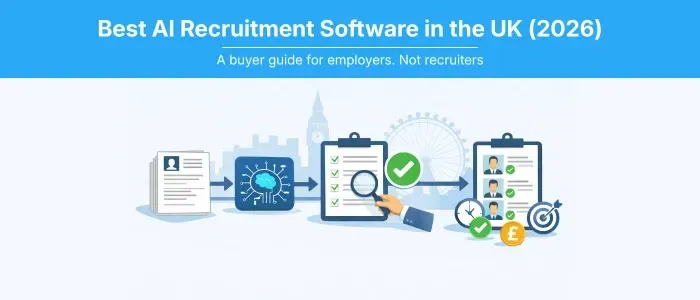
Best AI Recruitment Software in the UK (2026 Comparison Guide)
UK employers are under pressure to fill roles while skills shortages, salary costs, and workload continue to rise. At the same time, AI adoption in recruitment has accelerated, with screening, matching, and scheduling tools now embedded across many UK hiring workflows, according to StandOut CV.
If you are comparing the best AI recruitment software, you need more than a global tools list. You need clarity on which platforms work in real UK hiring conditions, how they handle data, and what impact they have on time to hire, cost per hire, and compliance risk.
This guide compares the leading AI recruitment tools used by UK employers in 2025. It explains where each platform fits by company size and hiring volume, and shows where SmartHire AI works best as a practical hybrid option for SMEs.
How to Use This Guide
Use Sections 1–3 to understand how AI recruitment software fits UK hiring workflows.
Use Sections 4–6 to compare platforms, features, and compliance considerations.
Use the scorecards and checklists to shortlist tools that fit your hiring volume and budget.
If you are an SME, focus on the SmartHire sections to evaluate hybrid AI plus recruiter models.
How We Evaluated AI Recruitment Software for UK Employers
This guide evaluates AI recruitment software from the perspective of UK employers, not recruiters or vendors. The goal is to help decision-makers compare tools based on real hiring outcomes, compliance risk, and operational fit.
Our Evaluation Criteria
Each platform was assessed using the same employer-focused framework.
1. Hiring Outcome Fit
We prioritised tools that improve time to shortlist, reduce screening workload, and support consistent hiring across recurring roles. Platforms designed only for sourcing or CRM tasks scored lower.
2. Human Oversight and Control
UK hiring decisions cannot rely on automation alone. Tools that support human review at shortlist and decision stages scored higher than systems that fully automate candidate rejection or ranking without intervention.
3. UK Compliance Readiness
We reviewed how each platform approaches GDPR obligations, candidate data handling, audit trails, and explainability. Tools that clearly support employer governance scored higher than “black box” systems.
4. Practical Use for SMEs
Many AI hiring tools are built for large enterprise teams. We assessed whether platforms are usable for UK SMEs with limited HR capacity, recurring roles, and cost constraints.
5. Transparency and Trade-Offs
Where vendors make performance claims, we looked for clarity around scope and conditions. Tools that explain limitations and usage boundaries scored higher than those relying on marketing language.
Evidence Standards Used
Our assessments are based on a combination of:
Public product documentation and feature descriptions
Vendor-published compliance and data-handling statements
Typical UK hiring workflows for manufacturing, healthcare, and logistics
Observable workflow design, not private benchmarks
We do not score tools using undisclosed internal data or unverified performance claims.
What This Guide Is Not
This is not a global ranking or affiliate list.
It does not assume one tool fits every employer.
It does not replace legal or HR advice.
The aim is to help UK employers understand which AI recruitment tools are appropriate for their hiring context, and where SmartHire AI fits as a hybrid option combining automation with recruiter validation.
Key Compliance Requirements for AI Recruitment Software in the UK
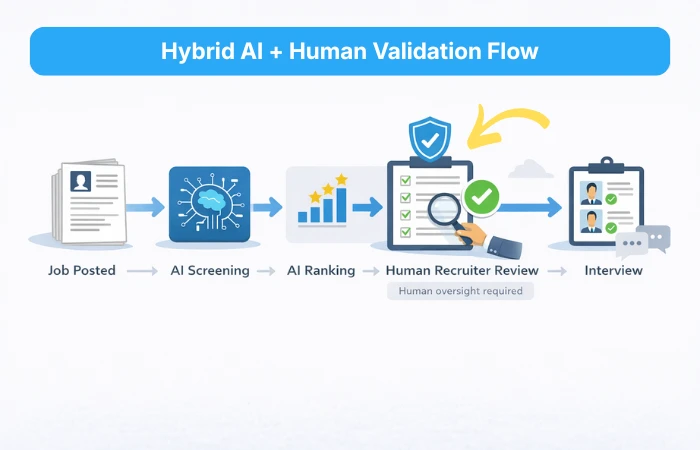
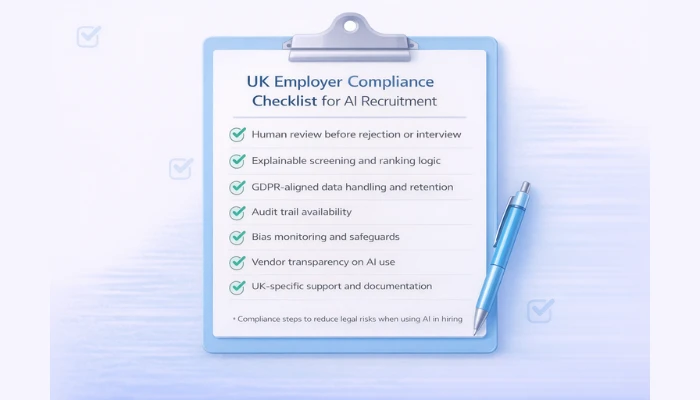
UK employers must treat AI recruitment tools as part of their hiring decision process, not as standalone software. Compliance responsibility stays with the employer, even when screening or matching is automated.
This section outlines the minimum compliance expectations UK employers should understand before using AI recruitment software.
GDPR and Automated Decision-Making
Under UK GDPR, employers must be clear about how candidate data is processed and how decisions are made. This includes:
Having a lawful basis for processing recruitment data.
Limiting data use to the purpose of hiring.
Ensuring candidates can request information about how decisions affect them.
Where automation is used, employers must avoid fully automated decisions that have legal or similarly significant effects on candidates without safeguards.
In practice, this means AI tools should support human review, not replace it.
Human Oversight and Decision Control
AI recruitment software should assist with screening and ranking, but final decisions must involve a human reviewer.
From an employer perspective, this requires:
The ability to review, override, or adjust AI-generated shortlists.
Clear visibility into why candidates are ranked or filtered.
A documented process showing human involvement before interview or rejection decisions.
Tools that automatically reject candidates without review increase compliance risk.
Transparency and Explainability
Employers must be able to explain hiring decisions if challenged. AI systems should therefore provide:
Clear scoring criteria linked to job requirements.
Reasonable explanations for candidate ranking or exclusion.
Audit trails that show how and when decisions were made.
Black-box systems that cannot explain outcomes place employers at risk.
Data Handling and Retention
Recruitment software should support:
Data minimisation. Only relevant hiring data is processed.
Secure storage and access controls.
Clear retention periods aligned with recruitment policies.
Deletion or anonymisation of candidate data when no longer needed.
Employers should also ensure vendors support data processing agreements and security standards suitable for recruitment data.
EU AI Act Awareness for UK Employers
Although the EU AI Act is not UK law, many AI recruitment vendors operate across EU markets. Employers using such tools should understand whether vendors treat recruitment screening as a higher-risk use case.
This is most relevant for UK employers using EU-based vendors or hiring across EU markets, where AI systems fall under cross-border regulatory scope.
From a UK employer perspective, this means asking vendors:
Whether human oversight is built into the workflow.
Whether bias testing and monitoring are in place.
Whether decision logs and audit records are maintained.
These questions support governance, even when legal requirements differ.
How SmartHire AI Approaches Compliance
The SmartHire AI shortlisting system is designed to support employer compliance rather than bypass it.
The platform:
Structures and scores candidates but does not make final decisions.
Requires human recruiter review before shortlists are delivered.
Maintains audit trails for screening and shortlist creation.
Supports GDPR principles around data use and transparency.
This hybrid approach allows employers to benefit from automation while retaining control over hiring decisions.
Comparison of Leading AI Recruitment Software Used in the UK
UK employers comparing AI recruitment software often encounter long feature lists with little clarity on trade-offs. This section focuses on how different tools behave in real hiring workflows, rather than marketing labels.For a broader view beyond employer-facing platforms, see more ideas for AI tools for recruiters.
The comparison below reflects how platforms are typically used by UK employers managing screening, shortlisting, and compliance.
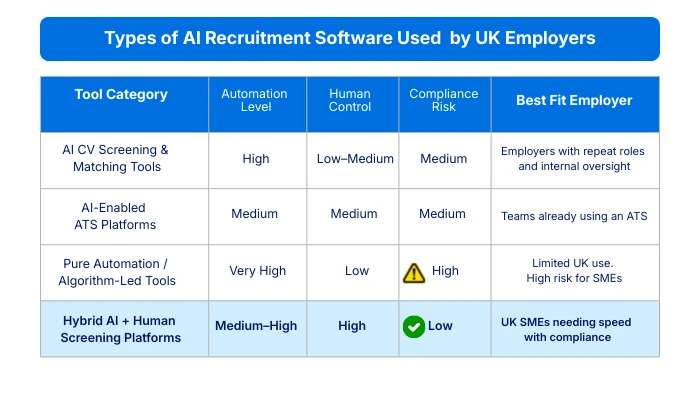
How to Read This Comparison
Each platform category is assessed on:
Primary use case in the hiring process
Level of automation vs human control
Suitability for UK SMEs
Compliance risk profile
Operational trade-offs
This is not a ranking. It is a functional comparison.
Tool Categories Commonly Used by UK Employers
1. AI CV Screening and Matching Tools
These tools focus on parsing CVs, scoring candidates against job descriptions, and ranking applicants.
Strengths
Reduce manual CV screening workload
Improve shortlist consistency
Handle high application volumes
Limitations
Often lack built-in human review stages
Explainability varies by vendor
May require integration with other systems
Employer fit
Best suited for employers with repeatable roles who want faster shortlists but still need oversight.
2. AI-Enabled ATS Platforms
These systems combine applicant tracking with automation features such as screening rules, scheduling, and reporting.
Strengths
Centralised hiring data
Workflow visibility
Integration with HR systems
Limitations
Automation features vary widely
Can be complex to configure for SMEs
Screening quality depends on setup
Employer fit
Useful for teams already committed to an ATS who want incremental automation rather than standalone screening.
3. Pure Automation or Algorithm-Led Tools
Some platforms emphasise fully automated matching or decision-making.
Strengths
Speed
Minimal manual input
Limitations
Reduced human control
Higher compliance and governance risk
Limited ability to explain decisions
Employer fit
Higher risk for UK employers in regulated or people-critical sectors.
4. Hybrid AI + Human Screening Platforms
Hybrid systems combine automation with mandatory human validation.
Strengths
Faster shortlists without losing oversight
Clear accountability for decisions
Better alignment with UK compliance expectations
Limitations
Less “hands-off” than pure automation
Requires coordination between software and recruiters
Employer fit
Well suited for UK SMEs needing speed, consistency, and compliance without full internal recruitment teams.
Where SmartHire AI Fits
SmartHire AI sits in the hybrid AI + human screening category.
It is designed for employers who:
Hire regularly in manufacturing, healthcare, or logistics
Need faster shortlists without agency dependency
Require human involvement before interview decisions
Want predictable costs and clear accountability
SmartHire automates early screening and ranking while ensuring every shortlist is reviewed by an experienced recruiter before delivery.
Key Trade-Offs Employers Should Consider
No AI recruitment tool removes decision responsibility from the employer. The real trade-off is speed versus control. Employers weighing this decision can compare AI and traditional recruitment agencies to understand cost, oversight, and delivery differences.
More automation increases speed but reduces visibility.
More human involvement increases assurance but adds coordination.
UK employers must decide where that balance sits for their roles, risk tolerance, and internal capacity.
What UK Employers Should Look for When Choosing AI Recruitment Software
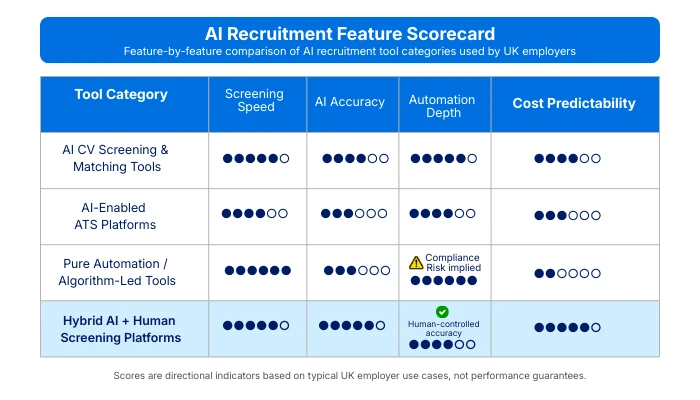
Choosing AI recruitment software is not about finding the most advanced technology. It is about selecting a system that fits your hiring volume, compliance obligations, and internal capacity.
UK employers should focus on practical decision criteria rather than feature breadth.
1. Clear Human Oversight at Decision Points
AI should assist screening, not replace hiring judgement.
Employers should confirm that:
Shortlists are reviewed by a human before interviews.
Hiring managers can override or adjust rankings.
No candidates are automatically rejected without review.
This reduces compliance risk and protects hiring quality.
2. Explainable Screening and Scoring Logic
Employers must be able to explain why candidates were shortlisted or filtered.
Look for tools that:
Link scores to job requirements.
Show which skills, experience, or criteria influenced ranking.
Avoid opaque “fit scores” with no explanation.
Explainability supports fairness and accountability.
3. Fit for UK Hiring Patterns and Sectors
Many AI tools are designed for global hiring models.
UK employers should check whether software:
Supports shift-based roles and location constraints.
Handles sector-specific requirements in manufacturing, healthcare, and logistics.
Reflects UK job structures rather than generic role taxonomies.
Poor sector fit leads to weak shortlists.
4. Practical Usability for SMEs
Complex systems increase admin burden instead of reducing it.
SME employers should assess:
Setup time and configuration effort.
Whether HR teams can operate the tool without technical support.
How screening results are delivered to hiring managers.
Usability affects adoption and ROI.
5. Transparent Cost Structure
AI recruitment software varies widely in pricing models.
Employers should understand:
Whether fees are flat or usage-based.
What costs scale with hiring volume.
How pricing compares to agency spend over time.
Predictable costs support better workforce planning.
6. Compliance Support, Not Just Claims
Compliance responsibility stays with the employer.
Before selecting a tool, employers should ask:
How candidate data is stored and retained.
Whether audit logs are available.
How human involvement is documented.
Vague compliance claims are not enough.
7. Integration With Existing Hiring Processes
AI software should fit into existing workflows.
Check whether the platform:
Works alongside current ATS or HR systems.
Exports shortlists cleanly.
Does not force a full process redesign.
Integration reduces friction.
Common Risks and Mistakes UK Employers Make With AI Recruitment Software
AI recruitment software can reduce workload and speed up hiring, but only when used correctly. Many problems arise not from the technology itself, but from how employers deploy it.
This section outlines the most common risks UK employers should avoid.
1. Treating AI as a Decision-Maker
Some employers expect AI to replace human judgement. This creates risk.
AI should support screening and ranking. It should not make final hiring decisions. Fully automated rejection or selection increases compliance exposure and weakens hiring quality.
Employers remain accountable for outcomes.
2. Assuming Compliance Is Handled by the Vendor
Using AI software does not transfer legal responsibility.
UK employers must still:
Inform candidates about data use.
Maintain lawful processing grounds.
Ensure human oversight is in place.
Respond to candidate requests or challenges.
Vendors provide tools. Employers govern decisions.
3. Applying Automation to the Wrong Roles
AI screening works best for structured, repeatable roles.
Applying automation to:
senior leadership roles
confidential appointments
highly specialised or niche positions
often produces poor results. These roles require targeted search and deeper evaluation.
Misuse leads to mistrust in the system.
4. Ignoring Data Quality and Job Design
AI reflects the inputs it receives.
Poorly written job descriptions, unclear requirements, or inconsistent role definitions reduce shortlist quality. Automation cannot fix unclear hiring criteria.
Employers must define roles properly before screening begins.
5. Overlooking Change Management
Even effective tools fail without adoption.
Employers should:
Train hiring managers on how to interpret scores.
Set expectations around human review stages.
Explain how automation supports, not replaces, recruitment teams.
Clarity improves acceptance.
6. Measuring Speed but Ignoring Quality
Fast shortlists alone do not deliver ROI. Employers should track, early attrition, interview-to-offer ratios and offer acceptance rates
Focusing solely on speed can mask quality issues.
Where SmartHire AI Fits for UK Employers

SmartHire AI is not designed to replace existing recruitment teams or systems. It is built to support employers who need faster shortlists, lower cost per hire, and consistent screening without increasing compliance risk.
Best-Fit Hiring Scenarios
SmartHire AI is most effective for employers who:
Hire regularly across similar roles.
Receive high volumes of CVs per vacancy.
Depend on agencies to meet hiring deadlines.
Operate in shift-based or operational environments.
Need predictable shortlists without expanding internal HR teams.
These conditions are common in manufacturing, healthcare, and logistics.
Role Types That Work Well
SmartHire performs best for roles with clear criteria, such as:
Production operatives, assemblers, and maintenance technicians.
Care assistants, support workers, and nursing roles.
Warehouse operatives, forklift drivers, and transport staff.
Administrative and operational support roles.
These roles benefit from structured screening and location or shift matching.
How SmartHire Complements Existing Systems
SmartHire is not a full ATS.
It works alongside:
Job boards and inbound applications.
Existing ATS or HR systems.
Internal recruitment or HR teams.
The platform focuses on screening and shortlisting. Hiring managers retain control of interviews and offers.
Human Oversight by Design
SmartHire automates early-stage screening and ranking. Every shortlist is then reviewed by an experienced recruiter before delivery.
This ensures:
Human judgement remains central to hiring decisions.
Screening outcomes can be explained.
Employers meet expectations for human involvement.
Automation accelerates process speed. Human review protects quality and compliance.
Cost and Operational Impact
By reducing agency reliance and screening hours, SmartHire helps employers:
Lower cost per hire.
Shorten time to shortlist.
Improve consistency across hiring cycles.
Results depend on role type, volume, and market conditions. SmartHire supports measurement so employers can assess impact over time.
When SmartHire AI Is Not the Right Choice
SmartHire AI is designed for structured, repeatable hiring. It is not intended to replace every recruitment method or role type. Clear boundaries help employers choose the right approach and protect hiring quality.
For some roles, automation adds little value.
Senior leadership and executive appointments require targeted search, discretion, and deep stakeholder engagement. These hires depend on judgement, context, and long-term fit rather than volume screening.
Highly specialised or niche technical roles may also fall outside SmartHire’s scope. When applicant pools are small and criteria are highly specific, manual search and specialist recruitment deliver better results.
Confidential hiring is another exception. Roles involving restructures, sensitive exits, or strategic change require controlled outreach rather than automated pipelines.
SmartHire works best when roles share common requirements and hiring occurs repeatedly. For complex or one-off appointments, traditional recruitment methods remain more effective.
Elate Staff supports both approaches. Employers can use SmartHire AI for volume and operational hiring, and switch to traditional recruitment where depth and discretion matter most.
Next Steps. How to Choose the Right AI Recruitment Software for Your Business
Choosing AI recruitment software should be treated as a controlled decision, not a technology upgrade. The goal is to reduce hiring cost and effort without increasing risk.
UK employers can move forward in a structured way.
Start by identifying one or two recurring roles where hiring delays or agency costs are highest. These roles provide a clear baseline for measuring impact.
Document your current metrics. This should include cost per hire, time to shortlist, screening hours, and reliance on agencies. Without a baseline, ROI is difficult to assess.
Trial automation in a limited scope. Use AI screening to reduce CV volume and generate shortlists, but keep human review in place. This allows teams to evaluate speed, quality, and compliance together.
Compare outcomes against your baseline. Look beyond speed. Assess shortlist quality, interview conversion, and early retention. These indicators matter more than raw automation.
Decide whether to expand usage based on evidence. Employers should only scale AI recruitment where it delivers measurable improvement without increasing governance burden.
SmartHire AI is designed to support this approach. It allows employers to test automation within existing hiring processes, measure results, and retain control over decisions.
Frequently Asked Questions About AI Recruitment Software in the UK
Is AI recruitment software legal in the UK?
Yes. AI recruitment software can be used in the UK when employers follow GDPR requirements and ensure human involvement in hiring decisions. Employers remain responsible for transparency, fairness, and decision oversight.
Does AI recruitment software replace recruiters or HR teams?
No. AI supports early screening and organisation of candidates. Recruiters and hiring managers still review shortlists, conduct interviews, and make final decisions.
Is AI recruitment suitable for small UK businesses?
It can be. AI recruitment software is most effective for SMEs with recurring roles and high application volume. Employers should prioritise tools that are simple to operate and provide clear oversight.
How do employers reduce bias when using AI recruitment tools?
Bias risk is reduced when tools use consistent criteria, structured scoring, and human review. Employers should avoid systems that rely on fully automated decisions without explanation.
How quickly can employers see results from AI recruitment software?
Results vary by role and market conditions. Employers often see faster shortlisting and reduced screening effort first. Cost and quality improvements should be measured over multiple hiring cycles.
Next Step. Evaluate AI Recruitment Software With Confidence
AI recruitment software can improve hiring outcomes when it is chosen carefully and used responsibly. UK employers should focus on tools that reduce workload, support compliance, and fit real hiring conditions.
If you are comparing options, the safest approach is to test automation on a limited number of roles, measure results, and scale only where value is proven.
SmartHire AI is built for this model. It combines automated screening with recruiter validation so employers can improve speed and control without increasing risk.
Book a SmartHire AI demo to see how the workflow operates in a real UK hiring context.