AI Candidate Screening: From 300 CVs to 10 Interview-Ready Hires in 72 Hours
How Can AI Screening Turn 300 CVs Into 10 Interview-Ready Candidates in 72 Hours?
Recruitment teams across the UK often face the same challenge: too many CVs, not enough time. For a single role, an HR manager or hiring lead can receive more than 300 applications. Manually reviewing each document, checking qualifications, and deciding who to shortlist can take weeks. For small and mid-sized employers, this delay not only stretches the hiring budget but also slows down business operations that depend on filling critical roles.
SmartHire was built to solve this problem. Instead of spending 18 days or more on manual screening, our AI candidate screening system creates an interview-ready shortlist of the top 10 applicants in about 72 hours. The process combines automated CV screening and AI candidate matching with recruiter-led validation to ensure both speed and quality.
In this article, we will:
Show how the SmartHire workflow works step by step (Day 0–3).
Share UK SME case examples from healthcare, finance, and logistics.
Demonstrate the return on investment with clear time-to-hire and cost-per-hire benchmarks.
Explain how recruiters use candidate scoring and structured scorecards to deliver reliable results.
Outline how SmartHire stays fully aligned with GDPR-compliant evaluation requirements in the UK.
By the end, you will see how 300 CVs become a shortlist of 10 interview-ready candidates in three days. This helps SMEs reduce hiring costs, speed up hiring, and focus on growth.
The Problem with Manual Screening Processes in Recruitment
For most small and mid-sized employers, hiring still starts the old-fashioned way: opening the inbox and working through CVs one by one. On paper, it sounds manageable. In practice, it is exhausting and expensive.
On average, UK employers now receive more than 300 applications per vacancy. Without automation, the process typically looks like this:
Initial review. HR teams spend hours scanning each CV to remove clearly unqualified applicants.
Detailed comparison. Remaining applications are checked against role requirements, often with inconsistent criteria between reviewers.
Shortlisting. Managers decide who to invite for interviews, balancing speed against the risk of overlooking good candidates.
This approach often stretches time-to-hire to 18 days or more for shortlisting alone. When projects are already waiting for new staff, these delays mean missed deadlines, extra costs, and frustrated teams.
For SMEs, the impact is magnified:
Overworked staff. Colleagues cover gaps while managers chase CVs, pulling focus away from operations.
Rising costs. Each additional week adds to hiring spend, whether through agency fees, lost productivity, or overtime.
Lower candidate quality. The best applicants often accept offers elsewhere before SMEs even reach the interview stage.
Consider a healthcare provider in Derbyshire. Faced with urgent staffing needs, their HR team spent weeks manually reviewing CVs for nursing roles. By the time interviews were arranged, many strong candidates had already taken jobs with faster-moving employers. The delay not only strained the team but also forced the organisation to pay higher agency fees to plug immediate gaps.
This is the reality of manual evaluation: long cycles, high costs, and missed opportunities. For SMEs with limited HR capacity, the need for a faster, more consistent approach is clear.
What Is AI Candidate Screening and How AI Tools Transform Talent Acquisition
AI candidate screening uses software to review and evaluate applications automatically. Instead of a hiring manager reading every CV line by line, the system completes an automated CV assessment in minutes. It checks for skills, qualifications, and experience that match the role, then ranks applicants by relevance.
The process usually starts with CV parsing, which extracts structured information such as education, job history, and certifications. From there, the system applies natural language processing to understand context. For example, it can recognise when a candidate’s experience in logistics management is transferable to a supply chain role, even if the wording in the CV is slightly different.
SmartHire adds another layer through AI candidate matching. Each applicant is scored against the job description using clear criteria. This candidate scoring allows recruiters to see, at a glance, which profiles are most aligned with the role. Instead of spending days building a shortlist manually, hiring teams can focus immediately on the top-ranked applicants.
Next, we turn the concept into a step-by-step workflow.
AI does not replace recruiters. It accelerates their work by removing repetitive tasks and adding a data-driven foundation. Recruiters remain in control, reviewing the evidence, adding judgement about cultural fit, and deciding who should move forward.
In simple terms, AI screening moves hundreds of CVs into a focused shortlist with far less effort. The result is faster hiring cycles, lower costs, and more consistent shortlisting decisions.
Now see how this works in a focused three-day sprint.
SmartHire 72-Hour AI Workflow: Step-by-Step Screening Process (Day 0–3)
The system is designed to give SME employers the one thing manual vetting can never provide: speed without sacrificing quality. The process is built as a structured three-day sprint. Each stage combines automation with human judgement to ensure that only the most relevant candidates make it through.
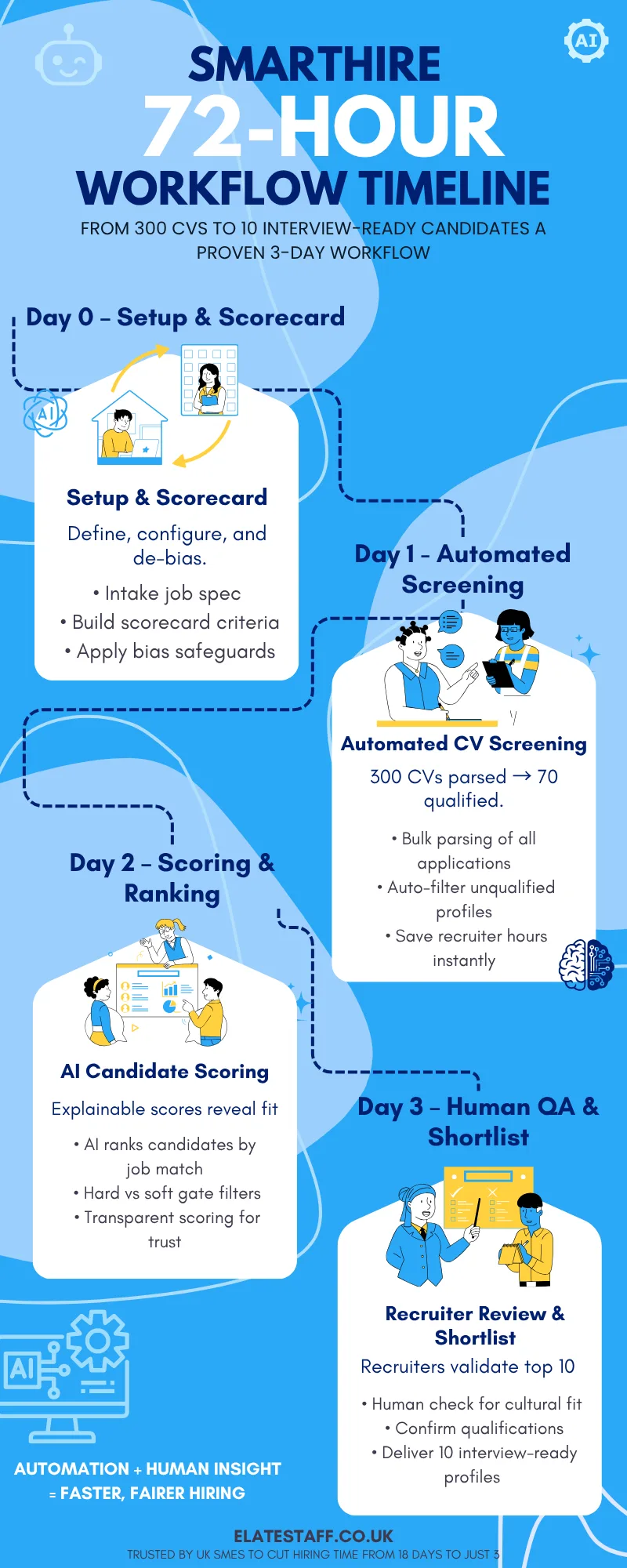
Day 0 – Recruitment Process Setup and Candidate Intake
Before any CVs are screened, the platform's recruiters sit down with the employer to define the hiring brief. This step typically takes no more than two hours but is critical to the success of the shortlist.
Define requirements. Hiring managers share the essential criteria: skills, certifications, years of experience, and must-have qualifications.
Configure the scorecard. The hiring manager set up the system with clear “hard gates” (e.g., nursing license required) and “soft gates” (e.g., two vs. three years of finance experience).
Bias safeguards. Filters are calibrated to minimise bias, ensuring the system focuses only on job-relevant data.
As one of our Hiring Managers puts it: “We decide hard vs. soft gates upfront, so the AI knows what to prioritise. That way, we never waste time with candidates who don’t meet the essentials.”
Day 1 – AI-Powered Tools CV Assessment and Candidate Screening Process
Once configured, the platform processes all applications in bulk. CV parsing begins:
Extracting data. The AI recruiting software pulls structured details such as education, work history, and certifications from every document.
Eliminating mismatches. Applicants who clearly do not meet basic requirements are automatically removed.
Reducing the pool. Out of 300 CVs, roughly 70–80 usually make it past this stage.
Instead of HR staff spending days on initial reviews, the system can complete this task in about four hours. Hiring managers are then free to focus on higher-value work analysing the shortlist and preparing for the next stage.
Day 2 – AI Candidate Scoring and Ranking Process
With the pool reduced, the system applies advanced candidate scoring:
AI candidate matching. Profiles are scored against the job description and employer-defined criteria.
Filters and gates. Hard requirements (e.g., license, degree) must be met, while soft factors influence ranking rather than exclusion.
Explainable scoring. The hiring manager can see why each candidate received a certain score, giving them transparency to trust the results.
This stage usually takes around six hours of automated analysis. Instead of a vague sense of “fit,” hiring teams now see a ranked list with evidence. As one hiring manager explains: “The AI doesn’t just tell us who looks good it shows us why. That makes it easier to explain our shortlists to managers.”
Day 3 – Human QA and Final Shortlisting of Candidate Profiles
The last stage is where technology and human expertise meet.
Review the top 20: Recruiters review the AI’s top-ranked candidates, assessing cultural fit, communication style, and role-specific nuances.
Create the shortlist: The final interview shortlisting process narrows the pool to 10 candidates. These individuals are not only qualified but also validated by a recruiter for alignment with company needs.
Prepare for interviews: Employers receive a clear candidate shortlisting pack with CVs, scores, and hiring manager notes.
The hiring manager remains in control of this stage. As one team member says, ‘AI gets us 80% there. The final 20% is human judgment
In three days, SmartHire moves from 300 CVs to 10 interview-ready candidates. Employers gain the best of both worlds: automation that saves time and human oversight that ensures quality.
With the process clear, here is what it delivers in time and cost.
ROI Snapshot: How AI Recruiting Tools Automate and Improve Recruitment Efficiency for SMEs
For SMEs, every week a role sits unfilled has a real cost. Projects stall, existing staff cover extra duties, and growth plans slow down. Hiring is not just about finding people it is about doing so quickly and without draining the budget. This is where AI candidate reviewing shows its biggest impact.
Industry benchmarks show the difference clearly:
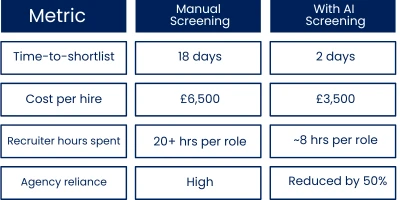
Faster Time to Hire
Manual processes often stretch the hiring cycle beyond 40 days. With SmartHire, the time-to-hire drops because the shortlist is ready in 72 hours. This means interviews start sooner, and offers are made before top candidates disappear to competitors.
Lower Cost per Hire
The average UK cost per hire is around £6,500 when agency fees, recruiter time, and lost productivity are factored in. By contrast, SmartHire brings that closer to £3,500. Savings come from reduced hours spent on evaluation, less overtime for staff covering gaps, and fewer last-minute agency placements.
Recruiter Hours Saved
Screening 300 CVs manually can consume more than 20 hours of HR time per role. SmartHire cuts that to less than half. Those saved hours can be redirected to interviewing, onboarding, and strategic HR projects instead of admin.
A Worked Example
Imagine a mid-sized logistics firm making 100 hires per year. Using a manual screening method:
Annual cost: £650,000 (100 hires × £6,500 each).
Time spent: 2,000 recruiter hours on screening alone.
Using SmartHire’s AI workflow:
Annual cost: £350,000 (100 hires × £3,500 each).
Time spent: 800 recruiter hours.
Result: A saving of £300,000 per year and 1,200 hiring manager hours freed. That equals the annual workload of three full-time employees redirected to higher-value work.
Why AI Recruiters Matter for SME Recruitment Efficiency
For large enterprises, these numbers are impressive. For SMEs, they are transformative. Reducing hiring costs by nearly half allows budgets to stretch further whether that means investing in staff training, expanding operations, or simply keeping the business running smoothly without constant firefighting.
The message is simple: AI screening does not just make hiring faster. It makes hiring financially sustainable for SMEs.
Those numbers come to life in real SMEs.
Real SME Case Studies: AI Recruitment and Matching in Action
Numbers matter, but what convinces most employers is seeing how the approach works for businesses like theirs. Here are three anonymised snapshots showing how AI candidate assessment has helped SMEs in different sectors across our region.

Healthcare SME in Derbyshire
A regional care provider urgently needed registered nurses to cover expanding patient demand. Their HR team was spending nearly three weeks manually sorting CVs. By the time interviews were arranged, many qualified candidates had accepted other offers. After adopting SmartHire, the provider received a shortlist of 25 interview-ready nurses in under three weeks. The speed meant they secured talent before competitors, avoided extra agency costs, and reduced staff burnout from unfilled shifts.
Logistics Firm in Sheffield
Hiring bottlenecks were forcing a logistics business to rely on costly temp staff. For one warehouse role, more than 250 applications arrived in a single week, overwhelming the HR manager. SmartHire cut through the pile in 72 hours, delivering a candidate shortlist of 40 people ready for interviews. Within 10 days, the role was filled, and overtime spending for existing staff was halved.
Finance Mid-Market in Nottingham
A growing finance firm struggled with analyst recruitment. Their process was slow, and agencies were charging high fees. By using SmartHire, they improved time-to-hire from 35 days to just 15. Over a year, this saved an estimated £250,000 in hiring spend while improving the quality of hires. Managers reported stronger retention because candidates were better matched from the start.
These stories reveal a clear pattern: across healthcare, logistics, and finance, SMEs gain from faster shortlisting, lower costs, and better-fit recruits. For employers competing in tight labour markets, speed and precision can mean the difference between building high-performing teams and constantly playing catch-up.
Why this works at scale comes down to the human-plus-AI balance.
Human + AI-Powered: The Smart Balance
Automation powers the speed. Human recruiters keep the process grounded. SmartHire was designed around a “human-in-the-loop” model where AI handles repetitive tasks, and hiring managers provide the judgment that only people can offer.
Here’s how the balance works:
AI for scale: Algorithms handle the heavy lifting parsing hundreds of CVs, filtering unqualified applicants, and producing candidate scores. This ensures no one is overlooked simply because the HR team ran out of hours in the day.
Hiring manager for context: Human reviewers step in once the AI assistant produces a ranked list. They evaluate cultural fit, soft skills, and role-specific nuances that no system can measure perfectly.
Scorecards explained: SmartHire separates “hard gates” (mandatory qualifications or licenses) from “soft gates” (preferred but flexible criteria). This structure keeps shortlisting consistent while still allowing human judgement to adjust the final call.
As one hiring manager put it: “AI flags the best profiles on paper. My role is to check whether those people also make sense for the team they’ll join.”
This partnership prevents common pitfalls of technology-driven hiring. It reduces false positives candidates who appear strong in data but turn out to be poor fits in practice and avoids false negatives, where high-potential talent gets overlooked due to unusual CV formatting or nontraditional career paths.
For SMEs, the result is reassurance. Employers know they are not relying on “black box” automation. Instead, they gain a faster shortlist backed by hiring manager validation, making it both efficient and trustworthy.
Speed and precision matter only with compliance. Here is how the process stays lawful in the UK.
GDPR Compliance and Ethical AI Screening Process in UK Recruitment
Speed only matters when the process remains compliant. In the UK, recruitment decisions are governed by the UK GDPR, which sets strict boundaries on how employers can apply automation in talent selection. SmartHire was designed with these regulations in mind, ensuring that AI shortlisting stays both effective and lawful.
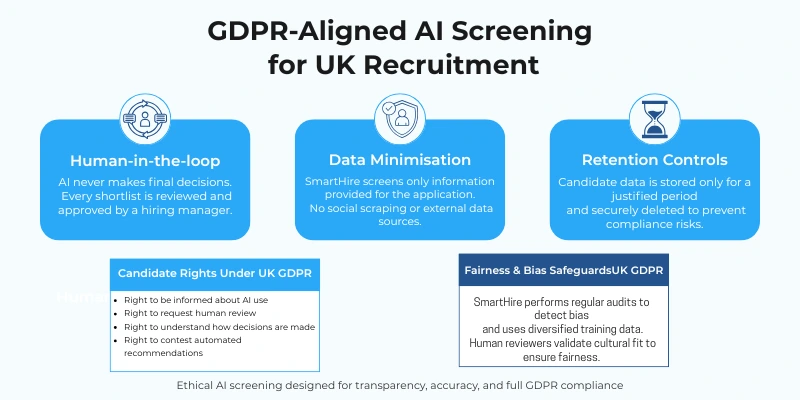
Key Compliance Principles
No fully automated rejection. Article 22 of the UK GDPR prohibits decisions that significantly affect an individual (such as rejecting a candidate) from being made solely by an algorithm. With SmartHire, AI recommendations are always reviewed by a hiring manager before final shortlisting.
Data minimisation. Only job-relevant information is collected and processed. Unlike some systems that scrape social media data, SmartHire restricts screening to the details a candidate provides for the role.
Retention limits. Candidate data is stored only for a defined and justified period, avoiding indefinite storage that risks breaching data rules.
Candidate Rights
Applicants have the right to:
Be informed when AI tools are used in the recruitment process.
Receive an explanation of how their application was assessed.
Request human review of automated recommendations.
Contest outcomes if they believe an error occurred.
Fairness and Bias Checks
Regular audits test for potential bias in candidate scoring. Training data is diversified to reduce the risk of reinforcing historical inequalities. The hiring manager also performs cultural fit reviews, which act as a safeguard against unfair outcomes.
For SMEs, this approach delivers confidence. Employers can adopt AI recruitment tools knowing they are faster and GDPR-compliant. Screening respects candidate rights and avoids reputational or legal risks.
So when should SMEs switch this on?
When Should SMEs Adopt AI Screening Tools for Recruitment?
AI candidate screening method delivers the most value when hiring process challenges are frequent and costly. For many SMEs, the question isn’t if they should adopt it, but when. Here are some clear indicators:
High application volumes. If a single vacancy attracts 200 or more CVs, manual review becomes overwhelming. AI shortlisting ensures qualified candidates are identified quickly without missing hidden talent.
Recurring hiring needs. Businesses making 50 or more appointments a year see the strongest return on investment. Each role adds up, and automation compounds the savings.
Lengthy recruitment cycles. If your time-to-appoint regularly stretches beyond 25 days, an AI agent can cut weeks from the process and help secure top candidates before they accept other offers.
Heavy reliance on agencies. If recruitment spend is being driven up by agency fees, the use of AI offers a way to reduce costs while maintaining hiring quality.
For SMEs with lean HR teams, these are critical decision points. The technology is not only for global enterprises. When recruitment challenges begin to slow operations or stretch budgets, AI recruiting screening provides a scalable and compliant solution that fits the realities of small and mid-sized businesses.
Teams ask similar questions as they plan adoption. Here are direct answers.
AI Screening FAQs for SME Recruiters
1. Is AI candidate screening legal in the UK?
Yes, AI screening is legal in the UK as long as it follows GDPR rules.
That means companies must stay transparent, include human review in hiring decisions, and avoid rejecting candidates based solely on automation. SmartHire is built with these rules in mind. It blends AI speed with hiring manager oversight, so every decision is both compliant and fair.
2. How accurate is AI compared to human recruiters?
Modern systems achieve around 87–93% alignment with human shortlisting decisions. AI excels at identifying objective skills and qualifications, while hiring managers are stronger at judging cultural fit and communication style. By combining both, SMEs gain consistency and speed without losing human judgement.
3. What if candidates use AI-written CVs?
AI can write impressive CVs but SmartHire doesn’t stop at surface-level polish.
Instead, it reads between the lines. The system looks for real-world experience, not just nice wording. Then during interviews, hiring managers double-check those details so you're judged on what you’ve actually done, not how fancy your resume sounds.
4. Can AI reduce bias in recruitment?
Yes, but only when safeguards are in place. SmartHire includes fairness audits, diverse training data, and hiring manager oversight to catch potential issues. By focusing on job-relevant criteria, AI can help reduce unconscious bias that sometimes influences manual candidate assessment.
5. What if we only receive 20–50 applicants per role?
Even at lower volumes, AI adds value by saving hiring managers time and ensuring no candidate profiles are overlooked. For SMEs, it also provides consistency in interview shortlisting, especially when HR staff juggle multiple roles at once. However, the ROI is strongest when dealing with higher volumes.
6. How much human input is needed?
The hiring manager remains central to the process. AI filters and ranks applicant tracking system, but humans make the final call. For example, recruiters review the top 20 candidates and deliver a validated candidate shortlist of 10 interview-ready individuals. This balance provides speed without removing human judgement.
7. Is it worth it for niche or specialist roles?
Yes, though the benefits differ. For niche roles with fewer applicants, AI ensures that the shortlist is built consistently and quickly. For high-volume roles, the advantage is scale. In both cases, AI reduces administrative load, freeing recruiters to focus on conversations with the best-fit candidates.
Put together, the path forward is clear.
The Future of Recruitment: AI Screening Tools That Transform Talent Acquisition
Recruitment does not need to drag on for weeks. With AI candidate screening, SMEs can transform a pile of 300 CVs into a 10-person interview-ready shortlist in just 72 hours. The combination of automated CV screening, candidate scoring, and hiring manager oversight gives employers both speed and confidence.
For healthcare providers, logistics firms, finance teams, and tech SMEs across Derbyshire, Sheffield, Nottingham, and South Yorkshire, the benefits are clear: faster time-to-hire, lower cost per hire, and better-fit candidates who stay longer.
SmartHire is more than a tool it is a practical solution designed to help SMEs reduce recruitment costs while staying fully compliant with GDPR.
👉 Ready to see it in action? Book a SmartHire demo today and discover how we can cut your next recruitment cycle in half.